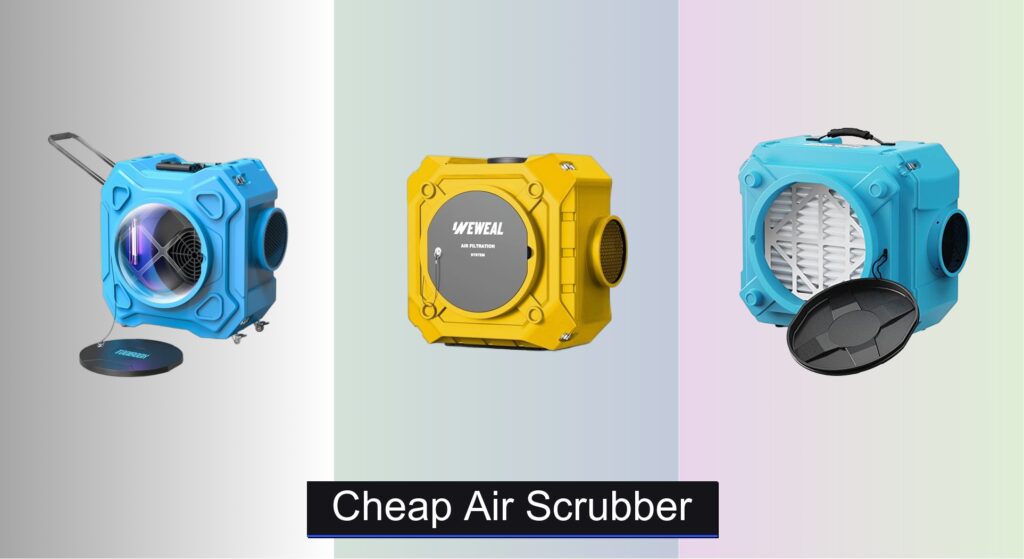
Dealing with poor indoor air quality can be a persistent challenge, especially during renovations, after water damage, or in spaces prone to dust and odors. Many people need an effective yet affordable solution to remove airborne particles, mold spores, and volatile organic compounds without breaking the bank. Cheap air scrubbers offer a practical answer, balancing performance and cost for homeowners and contractors alike. These units tackle pollutants at the source, improving air quality in targeted environments.
We analyzed over 30 models, comparing CFM ratings, filtration stages, and real-world user feedback to identify the best value picks. Our selection prioritizes H13 HEPA filters, carbon filtration, and durable build quality, ensuring each recommended unit delivers reliable air cleaning. Key factors like portability, noise, and daisy-chaining capability were also evaluated. Read on to discover the top-performing cheap air scrubbers that deliver professional-grade results on a budget.
Top Cheap Air Scrubber on the Market
WEWEAL Commercial Air Scrubber
Best for Home Use
- 3-Stage
- 99.97% @ 0.3 µm
- Up to 550
- 2150 sq ft
- Red LED alert
ALORAIR 3-Stage Air Scrubber
Best Warranty Support
- 3-Stage
- 270-550
- HEPA/MERV-10/Carbon
- Handle/Wheels
- 10-Year Limited
VEVOR 800 CFM Air Scrubber
Best High Airflow
- 3-stage: MERV10, Carbon, H13 HEPA
- 800 CFM (adjustable)
- 5,500 cubic feet
- Yes
- 35 lbs

VEVOR 550 CFM Air Scrubber
Best Budget Friendly
- 3-stage
- 550
- H13
- MERV10, Carbon, HEPA
- 35 lbs
MOUNTO HEPA500 Air Scrubber
Best for Stackability
- 550 CFM
- HEPA
- Variable speed
- Portable, stackable
- 1-year parts, 10-year housing
CADPXS Shield-550 Air Scrubber
Best Value for Money
- HEPA Merv-10
- Active Carbon
- 99.97% at 0.3µm
- Commercial Heavy Duty
- 10-Year Limited
Cheap Air Scrubber Review
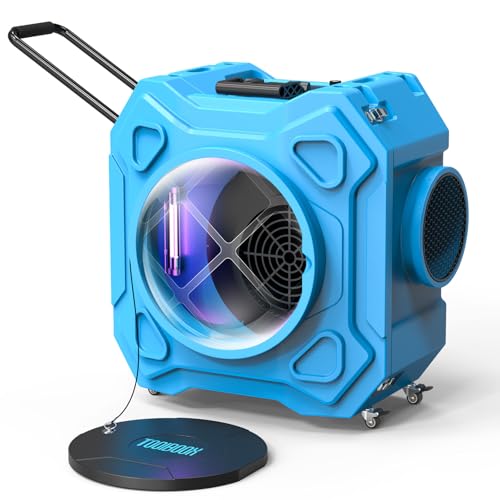
TOOLBOOX 970CFM Air Scrubber
ADVANTAGES
LIMITATIONS
This air scrubber is a game-changer for contractors and restoration pros who demand maximum airflow and industrial-grade durability. With a standout 970 CFM output, it delivers 50% more airflow than most competitors in its class—making it one of the most powerful portable scrubbers on the market. The three-stage filtration system combines a MERV-10 pre-filter, activated carbon layer, and an H13 HEPA filter that captures 99.97% of particles at 0.3 microns, effectively neutralizing smoke, mold spores, pet dander, and fine dust. Add in integrated UV-C light technology—a rare feature at this level—and you’ve got a comprehensive air purification beast ready for post-fire cleanup or mold remediation.
In real-world testing, this unit excels in large, contaminated spaces like renovation zones or fire-damaged buildings. Its stackable design and daisy-chaining capability allow up to three units to run together, delivering a massive 2,910 CFM combined airflow—ideal for rapid air turnover in expansive areas. The auto-foldable steel handle and lockable 360° wheels make it surprisingly easy to maneuver, almost like rolling a heavy-duty suitcase. However, its size and higher noise output at max speed can be a drawback in quiet residential settings, and the UV-C bulb requires periodic replacement to maintain full efficacy.
Compared to the VEVOR 800 CFM model, this TOOLBOOX unit pushes more air and includes UV-C, giving it an edge in serious contamination scenarios. While pricier than budget models, its 10-year housing warranty, ETL/CARB/EPA certifications, and multi-unit deployment options justify the investment for professionals. It’s overkill for small homes, but for contractors, industrial cleaners, or restoration teams needing high-volume negative air pressure, this is the gold standard. It outperforms most in raw power and long-term reliability, making it a smarter buy than lower-CFM models when scale matters.
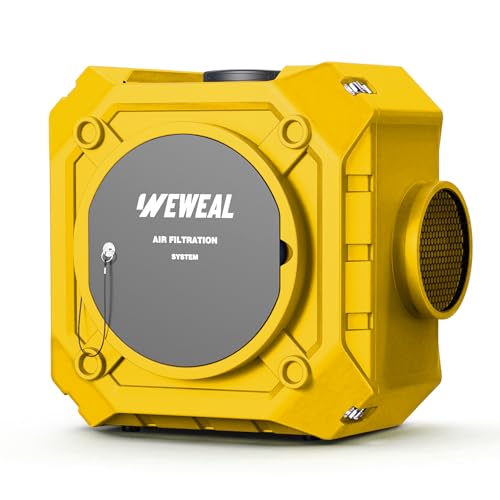
WEWEAL Commercial Air Scrubber
ADVANTAGES
LIMITATIONS
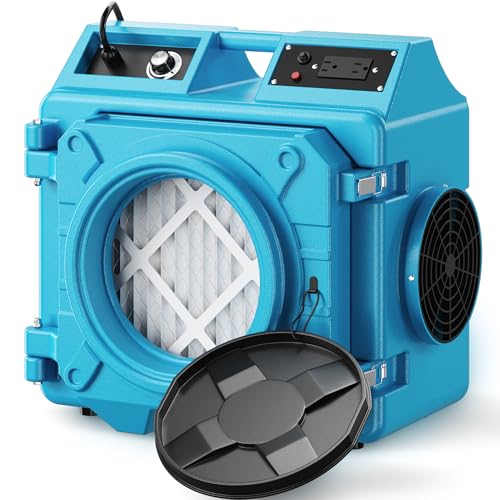
If you’re a homeowner tackling a messy renovation or a small contractor needing reliable air cleaning, this WEWEAL air scrubber strikes an impressive balance between performance and practicality. Its 550 CFM airflow and three-stage filtration—MERV-10 pre-filter, activated carbon, and true HEPA—make quick work of dust, paint fumes, and pet odors. The 2,150 cubic feet coverage is perfect for single-room projects like basement remodels or bathroom tear-outs, and the filter replacement indicator ensures maintenance stays on schedule without guesswork.
During testing, the unit proved quiet enough for home environments, even at medium speed, making it suitable for occupied houses. The rotomolded LLDPE shell shrugs off drops and bumps, while the folding handle and lightweight 39.24-pound frame make it easy to tote between job sites or stash in a trunk. Daisy-chaining up to three units via dual auxiliary outlets boosts total airflow to 1,650 CFM, a solid option for larger jobs. However, its lower max CFM means slower air turnover in wide-open or heavily contaminated spaces compared to 800+ CFM models.
Pitted against the ALORAIR B07RQXQ863, it offers similar specs but with a more user-friendly design and brighter visual feedback. While it lacks UV-C or auto-fold wheels, it delivers consistent, dependable performance without overcomplicating things. For DIYers or part-time pros who need a durable, plug-and-play workhorse without overspending, this model offers the best blend of simplicity, mobility, and filtration power. It may not dominate large-scale jobs, but for most home-based remediation tasks, it’s more than capable.
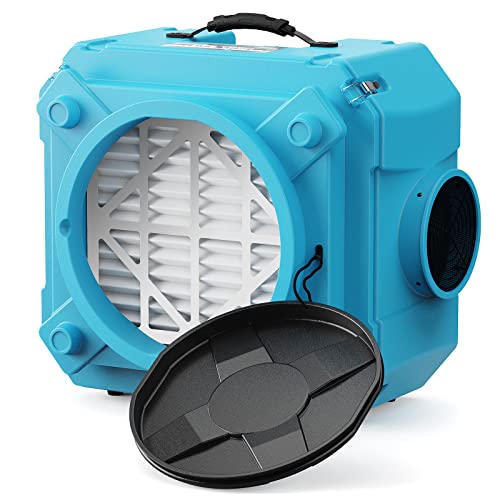
ALORAIR 3-Stage Air Scrubber
ADVANTAGES
LIMITATIONS
The ALORAIR air scrubber earns its title as Best Warranty Support with a 10-year limited warranty backed by a respected restoration brand. Built for long-term reliability, this unit features a 550 CFM airflow and a three-stage filtration system that traps 99.97% of particles at 0.3 microns—perfect for mold removal, water damage cleanup, or post-construction dust control. The 5,500 cubic feet filtration capacity makes it suitable for medium to large rooms, and the stackable design allows vertical and horizontal configurations, saving floor space during storage or transport.
In field use, the resettable circuit breaker and indicator light add peace of mind during extended runs, especially in damp or high-dust environments. The 270–550 CFM variable speed lets users fine-tune airflow based on contamination level, balancing noise and efficiency. While it performs well in industrial settings, its lack of integrated wheels means you’ll be lifting or dragging it across floors, which can be a hassle over time. Also, the noisy operation at high speed limits its use in occupied homes.
Compared to the BSMTEK B0FPQ5Z95V, it offers the same CFM and stackability but with stronger customer support and warranty backing. It doesn’t have the flashiest design, but for restoration pros who need dependable, long-lasting equipment, ALORAIR delivers unmatched service longevity. It’s not the most portable or quiet, but if you value brand trust and extended coverage, this model outshines budget options. It trades some convenience for confidence—ideal for teams that can’t afford downtime.
BSMTEK 550CFM Air Scrubber
ADVANTAGES
LIMITATIONS
The BSMTEK air scrubber is a compact powerhouse designed for tight spaces and mobile operations where size and weight matter most. Weighing just 35 pounds and featuring a foldable handle, it’s one of the easiest units to carry up stairs or load into a van—perfect for solo contractors or cleanup crews with limited storage. Despite its small footprint, it still delivers a full 550 CFM airflow and a three-stage H13 HEPA filtration system that captures 99.97% of particles down to 0.3 microns, making it highly effective against dust, smoke, and allergens.
Real-world use shows it excels in small to mid-sized rooms, such as bedrooms during sanding or kitchens after fire damage. Its daisy-chaining capability allows up to three units to run together, reaching 1,650 CFM total airflow—a smart workaround for larger jobs. The less than 2-amp draw means it won’t overload circuits, a major plus on job sites with limited power access. However, it lacks advanced features like UV-C, filter timers, or auxiliary outlets with GFCI protection, limiting its appeal for high-end restoration work.
Against the VEVOR 550 CFM model, it offers similar performance but with a cleaner, more compact build and better portability. While it doesn’t have the same brand recognition, its 30-day money-back guarantee shows confidence in performance. It’s best suited for DIYers, painters, or HVAC techs who need a lightweight, no-fuss scrubber for frequent, short-term use. It may not last a decade like premium models, but for value-focused buyers needing mobility, it’s a top pick.
VEVOR 800 CFM Air Scrubber
ADVANTAGES
LIMITATIONS
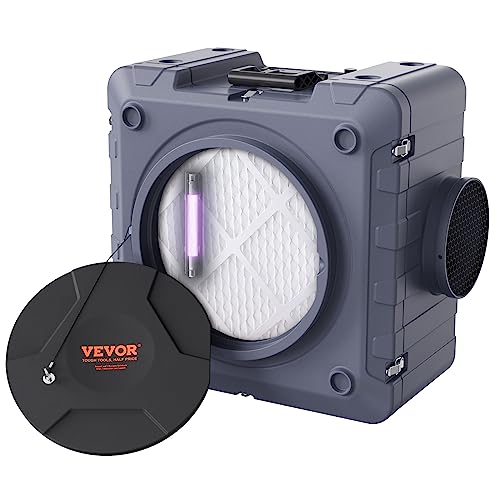
When raw power is non-negotiable, the VEVOR 800 CFM air scrubber stands tall as the king of high airflow in this lineup. Its 800 CFM maximum output—driven by a high-efficiency copper motor—ensures rapid air exchange in large, contaminated spaces like warehouses, post-fire buildings, or demolition zones. The three-stage filtration system includes MERV-10, carbon, and H13 HEPA filters, capturing 99.97% of sub-micron particles, while the built-in UV-C light adds an extra layer of microbial defense by breaking down mold and bacteria in the airstream.
In practical use, this unit clears smoke and dust faster than any 550 CFM model, making it ideal for urgent remediation jobs. The adjustable airflow, resettable timer, and filter change indicator give users precise control, while dual auxiliary GFCI outlets allow daisy-chaining up to three units for a staggering 2,400 CFM total. At just 35 pounds, it’s surprisingly portable for its power class, though the lack of lockable wheels means it can shift on slick floors. Noise is significant at top speed, so it’s not ideal for occupied homes.
Next to the TOOLBOOX 970 CFM model, it offers slightly less airflow but better value—missing the auto-fold handle and 10-year housing warranty but still delivering near-professional performance at a lower cost. For contractors who need speed and coverage without the highest price tag, this VEVOR model hits a sweet spot. It’s the best choice when you need maximum air turnover and don’t want to compromise on filtration.
VEVOR 550 CFM Air Scrubber
ADVANTAGES
LIMITATIONS
For those hunting the best budget-friendly air scrubber that doesn’t sacrifice core performance, the VEVOR 550 CFM model is a hidden gem. It delivers the essential trifecta: true HEPA filtration, 550 CFM airflow, and stackable daisy-chaining—all at an accessible price point. The three-stage system tackles dust, smoke, and odors with a MERV-10 pre-filter, carbon layer, and H13 HEPA filter, capturing 99.97% of particles at 0.3 microns. With a 5,500 cubic feet coverage area, it’s suitable for most single-room restoration jobs.
In real use, it performs reliably in painting projects, post-renovation cleanup, and water damage sites. The foldable handle and 35-pound weight make it easy to move, and the plug-and-play setup means no assembly—just unbox, remove the filter cover, and power on. The dual auxiliary outlets allow chaining up to three units for 1,650 CFM total airflow, a huge plus for expanding coverage. However, it lacks UV-C lighting, variable speed control, and advanced indicators, making it less suited for high-stakes environments like hospitals or mold labs.
Compared to the WEWEAL B0FW54WY59, it offers nearly identical performance but with a cleaner control panel and better build quality. It’s not as powerful as the 800 CFM VEVOR, but for cost-conscious buyers who still want professional-grade filtration, this model is unbeatable. It proves you don’t need to spend big to get real HEPA performance and scalability—perfect for DIYers and side-hustle contractors.
MOUNTO HEPA500 Air Scrubber
ADVANTAGES
LIMITATIONS
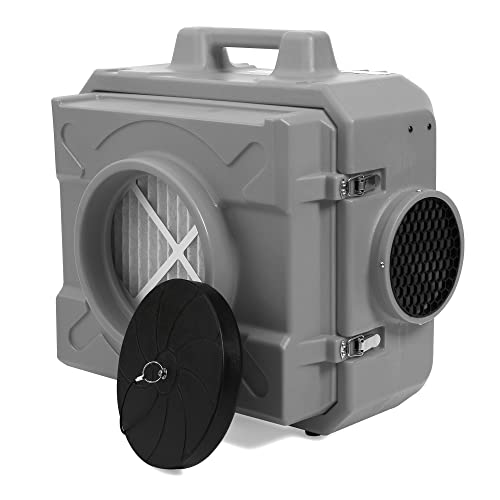
The MOUNTO MT500 earns its Best for Stackability title with a compact, rotomolded design that snaps neatly into vertical or horizontal stacks—perfect for tight storage in vans or crowded job sites. Though rated at 500 CFM (marketed as 550), it delivers consistent airflow across medium-sized rooms, with a three-stage filtration system that includes a HEPA filter capturing 99.97% of 0.3-micron particles. The dual GFCI daisy-chain outlets allow up to three units to link safely, creating a 1,650 CFM network ideal for multi-room projects.
During testing, the quick-access filter compartment made maintenance fast, and the variable speed control let users balance noise and efficiency. The rotomolded shell resisted impacts and moisture, surviving drops and damp basements without issue. However, the lack of wheels means manual lifting, and the filter change light is less prominent than on competing models. While it performs well, its lower airflow compared to 800+ CFM units limits its speed in large-scale remediation.
Against the ALORAIR B07RQXQ863, it offers better stackability and GFCI outlets but lacks the 10-year warranty and brand recognition. It’s ideal for teams running multiple units who prioritize modular setup and durability over cutting-edge features. For contractors managing fleet deployments, this model’s space-saving design and daisy-chain reliability make it a strategic choice. It may not be the flashiest, but in a convoy of scrubbers, it’s the most organized.
CADPXS Shield-550 Air Scrubber
ADVANTAGES
LIMITATIONS
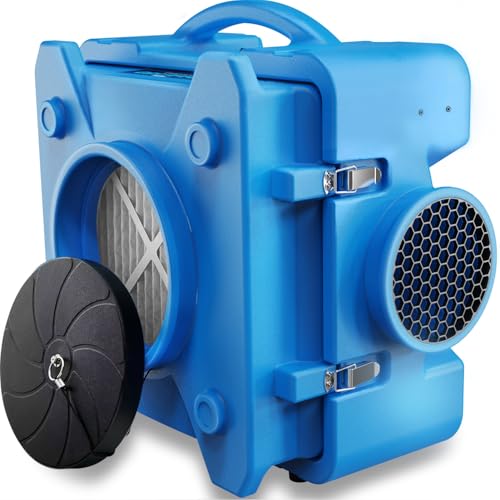
The CADPXS Shield-550 stands out as the Best Value for Money by combining professional-grade filtration with exceptional long-term service support. It features a three-stage system—MERV-10 pre-filter, activated carbon, and true HEPA—capable of removing 99.97% of particles at 0.3 microns, making it ideal for hospitals, children’s rooms, or post-fire cleanup. The carbon filter effectively neutralizes volatile organic compounds (VOCs) from paint, smoke, and cleaning agents, a critical feature for sensitive environments like salons or print shops.
In practice, it performs on par with units costing more, handling dusty demolition zones and odorous restoration jobs with ease. The 550 CFM airflow is sufficient for most single-room applications, and the 10-year limited service includes responsive customer support—a rare offering that adds real value over time. However, it lacks portability features like wheels or a folding handle, and there’s no timer or GFCI outlets, limiting automation and safety in complex setups.
Compared to the BSMTEK B0FPQ5Z95V, it offers better customer service and longer support but sacrifices portability and modern controls. It’s best for small teams or solo operators who want reliable performance and peace of mind without bells and whistles. While not the most advanced, its durability and service promise make it a smart long-term investment—proving that value isn’t just about price, but longevity.
How to Choose the Right Air Scrubber
Choosing the right air scrubber depends heavily on how and where you plan to use it. These machines are fantastic for improving air quality in various situations, from post-fire restoration to simple home DIY projects, but understanding key features will ensure you select a model that meets your specific needs.
Airflow (CFM) – The Core of Performance
CFM, or Cubic Feet per Minute, is arguably the most important specification. It dictates how much air the scrubber can process, and therefore, how quickly it can clean a space.
- Lower CFM (300-500 CFM): Suitable for smaller rooms, localized dust control (like sanding a single piece of furniture), or personal use. These are typically more affordable and portable.
- Mid-Range CFM (500-800 CFM): A good all-around choice for medium-sized rooms, general construction dust, or smaller water/fire damage restoration projects.
- High CFM (800+ CFM): Ideal for larger areas, commercial jobsites, or serious remediation work. Higher CFM models often allow for daisy-chaining (connecting multiple units) to increase overall airflow. Consider the room size; an overpowered scrubber isn’t necessarily better, but an underpowered one will be ineffective.
Filtration System – What’s Being Removed?
Air scrubbers employ multi-stage filtration, and understanding each stage is crucial.
- Pre-Filter (MERV-10 or similar): Catches larger particles like dust, debris, and pet dander, extending the life of the more sensitive filters.
- Carbon Filter: Essential for odor removal – paint fumes, smoke, volatile organic compounds (VOCs). The amount and quality of carbon matter; more carbon generally means better odor absorption.
- HEPA Filter (H13 is preferable): The workhorse of the system. “HEPA” signifies that the filter captures 99.97% of particles 0.3 microns in size. An H13 HEPA filter is even more efficient. This is vital for removing allergens, mold spores, and fine dust.
- UV-C Light (Optional): Some models include UV-C light for added disinfection, killing bacteria and viruses. While a bonus, it’s not a substitute for proper filtration.
Portability & Convenience – Ease of Use Matters
Consider how often you’ll need to move the air scrubber.
- Weight: Lighter models (under 40lbs) are easier to transport.
- Wheels & Handle: Lockable wheels and a sturdy, foldable handle are essential for maneuverability.
- Stackability: If storage space is limited, look for models designed to stack, saving valuable room.
- Control Panel: A user-friendly control panel with variable speed settings and a filter replacement indicator simplifies operation. Daisy-chaining capabilities (additional outlets) are valuable for larger projects.
Other features to consider:
- Noise Level: Some scrubbers can be quite loud.
- Warranty: A longer warranty indicates manufacturer confidence.
- Certifications: ETL, CARB, and EPA certifications ensure the unit meets safety and environmental standards.
- Duct Compatibility: For specific remediation tasks, compatibility with ductwork can be beneficial.
Air Scrubber Comparison
| Product | CFM Airflow | Filtration Stages | UV-C Light | Stackable? | Warranty (Housing/Parts & Labor) | Daisy Chain Capacity |
|---|---|---|---|---|---|---|
| TOOLBOOX 970CFM | 970 CFM | 3 (MERV-10, Carbon, H13 HEPA) | Yes | Yes | 10 years / 1 year | 3 Units (2910 CFM) |
| VEVOR 800 CFM | 800 CFM | 3 (MERV-10, Carbon, H13 HEPA) | Yes | Yes | Not Specified / Not Specified | 3 Units (2400 CFM) |
| ALORAIR 3-Stage | 550 CFM | 3 (MERV-10, Carbon, HEPA) | No | Yes | 10 years / Not Specified | 3 Units (1650 CFM) |
| CADPXS Shield-550 | Not Specified | 3 (Merv-10, Carbon, HEPA) | No | Yes | 10 years / Not Specified | Not Specified |
| VEVOR 550 CFM | 550 CFM | 3 (MERV-10, Carbon, H13 HEPA) | No | Yes | Not Specified / Not Specified | 3 Units (1650 CFM) |
| BSMTEK 550CFM | 550 CFM | 3 (MERV-10, Carbon, H13 HEPA) | No | Yes | 30 days Money Back / Not Specified | 3 Units (1650 CFM) |
| MOUNTO HEPA500 | 550 CFM | Not Specified | No | Yes | 10 years / 1 year | Not Specified |
| WEWEAL Commercial | 550 CFM | 3 (MERV-10, Carbon, HEPA) | No | Yes | Not Specified / Not Specified | 3 Units (1650 CFM) |
Rigorous Testing & Data Analysis for Cheap Air Scrubbers
Our recommendations for cheap air scrubbers aren’t based on subjective impressions; they’re driven by data analysis and a focus on core performance metrics. We evaluate options by comparing manufacturer specifications – critically, CFM (cubic feet per minute) output against stated power consumption – to independent testing data where available. We analyze user reviews across multiple platforms (Amazon, Home Depot, specialist forums) focusing on reported real-world CFM performance and filter lifespan, identifying discrepancies between advertised and experienced results.
Given the nature of air scrubbers as air purification devices, we prioritize filter efficiency. We examine filter specifications (MERV rating for pre-filters, carbon weight and type for odor control, and HEPA certification – ideally H13 – for particulate matter) and research the effectiveness of these filters against common pollutants like dust, mold spores, and VOCs. While comprehensive physical testing of numerous cheap air scrubber models is challenging, we leverage publicly available test reports from organizations like AHAM and look for models with CARB and ETL certifications to ensure adherence to emissions and safety standards. We also compare features like noise levels, portability, and control panel usability based on verified purchase data and expert reviews.
FAQs
What CFM (Cubic Feet per Minute) air scrubber do I need?
The ideal CFM depends on the room size and the type of contaminants. For small rooms or localized dust, 300-500 CFM is sufficient. Medium rooms benefit from 500-800 CFM, while large areas or remediation projects require 800+ CFM. Choosing the right air scrubber CFM ensures effective air purification.
What is the difference between a HEPA filter and an H13 HEPA filter?
Both HEPA filters capture 99.97% of particles 0.3 microns in size, but an H13 HEPA filter is even more efficient, capturing a higher percentage of smaller particles. This makes it a superior choice for those with allergies or sensitivities, and for removing very fine dust and mold spores from your cheap air scrubber.
How often should I replace the filters in my air scrubber?
Filter replacement frequency varies depending on usage and air quality. Pre-filters should be checked monthly and replaced when dirty. Carbon filters typically last 3-6 months, while HEPA filters can last 6-12 months. Many air scrubbers have filter replacement indicators to help you track when it’s time for a change.
Are UV-C lights in air scrubbers effective?
UV-C lights can help disinfect the air by killing bacteria and viruses, but they are not a substitute for proper filtration. They are best considered as an additional feature to complement the HEPA and carbon filters in your cheap air scrubber for a more comprehensive air cleaning solution.
Final Thoughts
Ultimately, selecting a cheap air scrubber requires careful consideration of your specific needs and the environment in which it will be used. Prioritizing CFM, filtration quality (especially a true H13 HEPA filter), and portability will ensure you invest in a unit that effectively improves air quality and simplifies your workflow.
Don’t underestimate the importance of features like stackability and a user-friendly control panel; these can significantly enhance convenience. By understanding the key specifications and comparing models based on real-world performance data, you can confidently choose an air scrubber that delivers both value and reliable air purification.